A practical gifting guide should probably start with the thing most gift guides won’t say out loud: a huge amount of gift spending is wasted every year on things that never get used and quietly end up donated within a few months.
GiftAFeeling’s 2025 research put a number on it — more than $9.5 billion is wasted annually on unwanted gifts in the US alone, and the average person wastes about $71 per gift that never lands. That’s not really a budget problem. The gifts that fall flat aren’t disproportionately the cheap ones. They’re the generic ones — items picked to say “I got you something” rather than “I got you this, specifically.”
The same research found 62% of people would rather have a cheap but meaningful gift than an expensive store-bought one, and Deloitte’s consumer data shows 36% of buyers actively prefer personalized gifts. The global personalized gifts market was worth $51.98 billion in 2024 and is on track to hit $138 billion by 2030 — growing at nearly 13% a year, driven by one simple thing: people will pay for evidence that someone was paying attention.
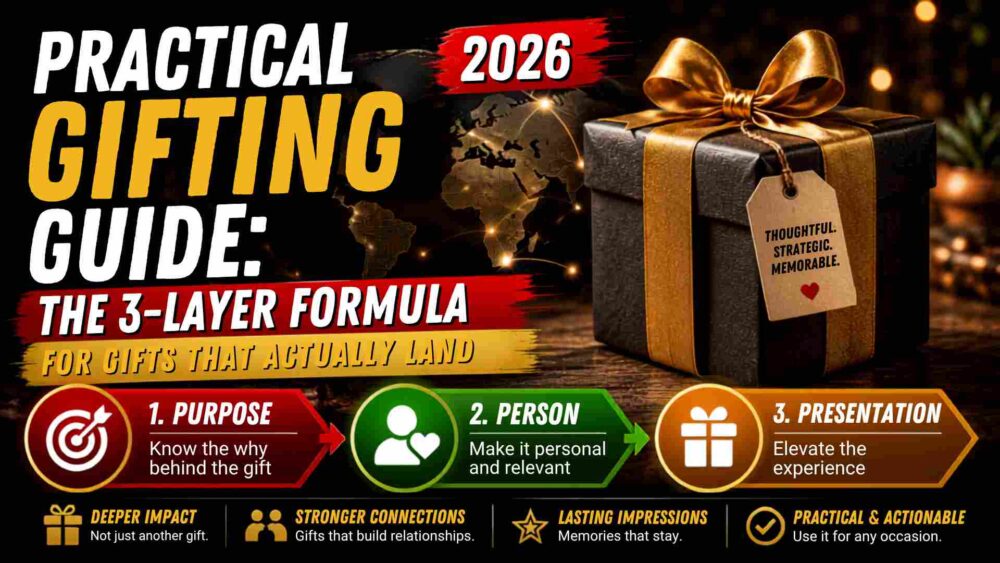
That’s the whole idea behind the 3-Layer Gift Formula below. It’s not a shopping category list or a seasonal trend roundup — we’ve covered plenty of that ground in our ultimate guide to meaningful gifting. This is more of a decision structure: why some gifts get remembered a decade later and others are forgotten in a matter of weeks, and how to reliably land on the former no matter your budget, relationship, or how much time you have.
1. The $9.5 billion gift waste problem — what it actually tells us
Americans spend a lot on gifts. NRF data puts the average Christmas-season spend at $997.73, and once you fold in birthdays, anniversaries, Valentine’s Day, Mother’s Day, Father’s Day and everything else, the average person’s annual gift spend creeps toward $1,800. Against that backdrop, $9.5 billion in waste is a striking number — and it’s not a rounding error, it’s a pattern.
Look closely at the research and the same failure modes keep showing up:
- Generic selection — the gift came from browsing “gifts for [category]” rather than from actually knowing the person.
- Price-led decisions — spending enough took priority over knowing enough, so the item communicates investment but not attention.
- Occasion-driven giving — bought because the calendar demanded it, not because there was a real reason for this person.
- The “practically useful” trap — pure utility with zero personal dimension, which ends up feeling more like household restocking than a gift.
None of those four are really about money. They’re about orientation. Ask “what should I get someone in this category” and you get a generic answer at any price point. Ask “what do I actually know about this person that I could reflect back to them” and the answer changes completely — again, at any price point.
2. The psychology of gift reception
Gift satisfaction research keeps landing on the same handful of psychological mechanisms, and they explain a lot about why price alone doesn’t predict how a gift lands.
The specificity signal
A study in the Journal of Consumer Psychology on gift personalization found something counterintuitive: a $35 personalized gift was rated as more valuable than a $75 generic one. Researchers call this the specificity signal — the more specific a gift is, the more it tells the receiver “I was thinking about you, not just fulfilling an obligation.” That perceived effort is what drives the emotional reaction, not the receipt total.
Reciprocity
Robert Cialdini’s classic work on persuasion showed that gestures which read as genuine — rather than as social performance — trigger a strong reciprocity response. Gifting studies back this up: gifts that feel personal produce noticeably stronger feelings of connection and gratitude than generic ones. It’s part of why a modest gift with a handwritten note so often beats an expensive item with no message attached.
Experiences vs. objects
Cornell’s Thomas Gilovich found that experiences tend to produce more lasting satisfaction than objects of equal value, mostly because experiences become part of someone’s personal story in a way possessions rarely do. That doesn’t mean “always buy experiences” — it means gifts that create any kind of experience, including the experience of feeling seen or delighted, tend to outlast purely functional objects in people’s memory.
What people actually remember
Ask someone weeks later what they remember about a gift they received, and three things come up again and again:
- Evidence the giver was paying attention — a reference to something specific they said or noticed.
- The note or story attached to it — usually remembered longer than the object itself.
- A moment of genuine surprise, which colors how the whole thing gets remembered.
The 3-Layer Formula is really just built around those three things.
3. The 3-Layer Gift Formula — Practical, Personal, Playful
Instead of the usual “what should I get them,” try answering three narrower questions:
- Practical — does it fit their actual daily life? Does it remove friction or upgrade something they already use?
- Personal — does it reflect something specific about them, or about your history together?
- Playful — is there a moment of surprise or delight in how it arrives?
You don’t need all three in equal measure. Sometimes Practical is 80% of the gift and Personal is a single well-written note. Sometimes Playful carries the whole thing and Practical is almost incidental. Think of it less as a checklist and more as a diagnostic — before you buy anything, ask which of the three is present, which is missing, and whether the missing one is easy to add.
A useful gut check: when they open it, will they think “you used this and thought of me,” “you actually know me,” or “this made me smile”? If none of those apply, it’s worth reconsidering.
4. Layer 1 — Practical
Practical doesn’t mean boring — it means the gift genuinely fits how this person lives, which takes real attention to their habits, their recurring small complaints, and the stuff they use constantly but never get around to upgrading themselves.
Finding the practical layer
Honestly, the best source for practical ideas isn’t a gift guide at all — it’s conversations you’ve already had. People mention small frustrations and half-formed wants constantly; the problem is those comments are easy to forget by the time a birthday rolls around.
A trick that actually works: keep a running note on your phone for each person you regularly buy for. Whenever they mention a habit, a complaint, or something they keep meaning to buy, jot it down. A month later, when you need a gift, the research is already done.
A few examples by friction category
Physical comfort — the friend with the bad back gets a lumbar cushion, the parent who’s on their feet all day gets a proper foot massager, the partner who’s always cold gets a genuinely good heated blanket. These feel less flashy than an occasion-driven purchase, but they get used daily, which is exactly why they land.
Daily habits, upgraded — the coffee-serious partner still using a basic grinder gets a Baratza Encore. The friend who journals in a cheap notebook gets a Leuchtturm1917. Upgrading something someone already uses every day is about as reliable as gifting gets, because the value shows up daily instead of once.
Tech convenience — a good power bank for the person whose phone dies every afternoon, an AirTag for the one who’s always losing their keys, a proper cable management setup for the sibling working from a cluttered desk. Tech gifts have high staying power specifically when they solve a problem the person has actually mentioned.
Home environment — a seat cushion for the reading chair someone’s complained about, a Victorinox knife for the sibling whose kitchen knives are a joke, drawer organizers for the parent who keeps meaning to sort the bathroom. These take real knowledge of someone’s home, which is why they end up landing as both Practical and Personal at once.
The quick test: can you picture this specific person using it at least three times a week? If yes, the Practical layer is there. If you’re guessing, it probably isn’t.
5. Layer 2 — Personal
If the research on gift satisfaction points anywhere consistently, it’s here. It’s also the layer people skip most often, because it takes actually thinking about this one person instead of a category.
The personalized gifts market growing at almost 13% a year isn’t mostly people buying monogrammed mugs — it’s a cultural shift, particularly among Millennials and Gen Z (50% of whom actively prefer personalized gifts per Statista 2024), toward specificity as a stand-in for care, regardless of price.
There are really two angles here. Who they are as a person — their interests, humor, aesthetic, the stuff they’re quietly obsessed with. And who you are together — the shared history, the inside jokes, the trip that went sideways, the phrase only the two of you use.
Adding it without a separate purchase
The Personal layer doesn’t need its own budget line. You can layer it onto almost any Practical gift through:
- A short, specific note — one memory, one genuine compliment, one forward-looking wish (more on the exact formula in section 10).
- A personalized detail — engraving, a specific color, a particular edition — anything that makes it “the version chosen for you” instead of “the generic one.”
- Curated content — a playlist with a line about why each song’s on there, a set of photos, a short video.
- The story behind it — why you picked it, what you noticed. The same lumbar cushion becomes something else entirely paired with “I’ve noticed you always rub your back after sitting — I want you comfortable for a lot more years of whatever you’re doing in that chair.”
Try this before you buy anything: spend three minutes writing down five specific memories or small observations about the person. They don’t need to be significant — the smaller and weirder, the better. “They always order the same thing at their favorite spot.” “They bring up that one trip constantly.” One of the five will usually suggest a gift. Another will become the note.
6. Layer 3 — Playful
Peak-moment research on gift-giving keeps pointing to one thing: a moment of surprise or humor tends to become the anchor memory — the specific beat that colors how the whole thing gets remembered.
Playful doesn’t mean novelty gifts or gag items. It means something about how the gift arrives creates a real smile, not a polite one.
Surprise timing — sending something on a random Tuesday with “no reason, just thought of you” tends to land harder than the same gift on cue for an occasion, because it strips out the performance element entirely.
The layered reveal — a box inside a box, a card that leads to a hunt for the actual gift. Kids get this instinctively; most adults have stopped bothering.
The inside joke — one small, cheap add-on that only the two of you would understand often becomes the most-talked-about part of the gift years later.
An unexpected medium — a video instead of a card, a letter in the post when you live three blocks apart, or a card that triggers an AR video in the room instead of on a screen — that’s the whole premise behind MessageAR, and we go deeper on this in our guide to personalized video greetings if you want more ideas.
Something handmade — not everyone can craft, but almost anyone can bake, write, or assemble something. It signals time invested in a way a purchase can’t fake.
7. How the three layers work together
Each layer covers for the weaknesses of the other two:
- Practical alone feels utilitarian — appreciated, used, but never mentioned as “the meaningful gift.”
- Personal alone can feel earnest but impractical, especially if the sentiment lands but the object doesn’t actually serve them.
- Playful alone is fun in the moment and forgettable a week later.
Put all three together, even minimally, and you get the reaction that actually sticks — “how did you know?” That’s not luck. It’s just what happens when the three variables show up at once.
Minimum viable version of each:
- Practical: anything that solves a real, stated daily friction — price doesn’t matter.
- Personal: a three-sentence handwritten note using the formula in section 10.
- Playful: unusual timing or delivery — a Tuesday gift, a wrapped layer, a card that leads somewhere unexpected.
A $20 practical item, a specific handwritten note, and an odd delivery moment will consistently outperform a $200 generic gift on every measure the research tracks.
8. Applying the formula by relationship
For a partner
The tricky part with partners is that generic is more visible, not less — they know you know them well. Personal has the highest ceiling here. Practical: look at their daily habits — what’s the cheap version they’re still using? Personal: something specific to your shared history, not “my partner” but “you, specifically.” Playful: for a long-term partner, this often means breaking routine — an unexpected occasion, an unusual delivery, something that gets a genuine reaction instead of a rehearsed one.
For a parent
Parents genuinely mean it when they say they don’t need anything. What lands is usually about being seen as a person, not just as “mom” or “dad.” Practical: comfort and small luxuries they’d never buy themselves. Personal: a specific memory or quality you admire, not a generic “you’re a great parent” — see our gifts for dad guide for more ideas tailored to this. Playful: an unexpected medium works especially well here — a video they didn’t see coming, a message coordinated across the family.
For a close friend
Friends give you the most room to work with. Practical: their specific hobby, or an upgrade to something they’re already into. Personal: the inside joke, the shared memory — friend gifts have the richest Personal layer because the shared history is deep. Playful: friends tolerate genuinely playful gifts better than anyone, so use that latitude.
For a colleague
Professional context puts a ceiling on Personal and requires some care with Playful. Practical: desk, commute, coffee — safe territory that doesn’t feel presumptuous. Personal: acknowledge something about their work rather than anything too intimate — “I know you run on coffee and I’ve never seen you without a lukewarm one” works fine. Playful: small and warm, calibrated to your actual working relationship.
9. The formula at every budget level
| Budget | Practical | Personal | Playful |
|---|---|---|---|
| Under $20 | A small item in their specific friction category | A handwritten note — one memory, one observation | Odd timing or medium — Tuesday delivery, a card that links to a short video |
| $20–$60 | An upgrade on something they already use daily | Engraving, a specific color, a curated selection | A layered reveal or a card with a linked video |
| $60–$150 | A meaningful upgrade — noise-cancelling earbuds, a good kitchen tool | A custom photo book, jewelry with a meaningful date, a commissioned illustration | An AR-triggered video, an unexpected postal delivery, a coordinated group message |
| $150+ | A deferred experience or a wanted piece of tech | A video tribute from people across their life, a commissioned piece tied to shared history | The trip they mentioned but never planned, turning an ordinary occasion into a milestone |
10. Why the note matters more than people think
Recipients tend to remember the accompanying note longer, and recall it more often, than the object itself. A gift with no note says “I got you something.” The note is what actually says what you mean.
The 3-sentence formula:
- One specific memory or observation — specific enough that it couldn’t have been written for anyone else.
- One reason this particular gift — the link between what you know about them and what you picked.
- One genuine, forward-looking wish — not “hope you have a great day,” something tied to their actual life right now.
Handwritten, always. The handwriting itself signals the same thing the specificity does — that this couldn’t have been delegated or automated.
For people who genuinely don’t want more stuff — parents who “have everything,” friends downsizing — a full-page version of this formula is often the best gift you can give.
11. Blending physical gifts with digital moments
The most consistent shift in gifting lately is the hybrid format — a physical item paired with, or unlocking, a digital moment. Not tech for tech’s sake; it’s that a physical object holds permanence while a digital moment delivers presence, and combining them covers two of the three things people actually remember: evidence of attention, and a moment of delight.
For a short personal video: Loom works well for a quick, free video you can attach as a QR code on a card. Google Drive or Dropbox is the simplest option if you just need a shareable link. For anything informal, sending a video over WhatsApp or iMessage right around the gift’s arrival does the job.
For a group tribute video: Tribute is built specifically for collecting contributions from several people into one video. Kudoboard works well for workplace gifting where a lot of colleagues want to chip in.
For an AR experience: this is where MessageAR fits — attach a personalized video to a physical card or gift, and the recipient scans it and the video plays in their actual space rather than on a screen. No app download needed on their end. It’s particularly effective for the Playful layer since the reveal itself tends to be the most memorable part of the whole gift — we cover the setup step by step in our personalized video greetings guide.
For a digital card: Canva’s free tier is plenty for most personal cards. Touchnote converts a digital photo into a physical postcard — a nice inversion of the usual digital-to-physical direction, and surprisingly effective for very little effort.
The tool matters less than the principle: pick whatever’s easiest for the recipient to actually experience. A setup that requires troubleshooting kills the Playful element before it even starts.
12. Seven common gifting mistakes
- Shopping from “gifts for [category]” instead of from what you know about this person. Category browsing gets you a category-average gift for a category-average person, and your person isn’t that.
- Confusing expensive with thoughtful. The average wasted gift costs $71 — expensive generic items get discarded just as often as cheap ones. Specificity is the variable, not price.
- Skipping the note. It’s the most consistently remembered part of any gift, and three specific handwritten sentences add more than doubling the budget would.
- Buying what they should want instead of what they do want. The unrequested gym membership, the habits book nobody asked for — these can read as “you should be different,” which tends to backfire.
- Defaulting to gift cards as the whole gesture. Fine as a supplement alongside something specific; as a standalone gift for someone you know well, it can read as “I couldn’t think of anything.” The exception is someone who’s explicitly said they’d rather pick their own.
- Panic-buying at the last minute. Time pressure kills specificity, which is the one thing that actually drives emotional impact. A running note on your phone (see section 4) heads this off before it happens.
- Picking something that matches your taste, not theirs. The thing you’d want to own is only the right gift if they share your aesthetic — when in doubt, default to their colors and their style, not yours.
13. Quick examples
Partner, $40, birthday — They’ve mentioned wanting better coffee at home and always stop at the same cafe. Buy a bag of specialty beans from that exact roaster. Note: “I know you’ve been saying you wanted to make this at home since our first trip there — happy birthday, here’s to more mornings with fewer excuses.” Tuck in an old receipt from a date you both remember, dug out of your camera roll.
Parent, any budget, no occasion — They mention their back constantly and have had the same chair for fifteen years. Ship a good lumbar cushion, unannounced. Card arrives the next day: “I noticed you rub your back every time you get up from that chair. Want you comfortable for a lot more years of [whatever they actually do in it]. No occasion — just thought of you.” The random-Tuesday factor is the Playful layer here, no extra effort required.
Close friend, 30th birthday, $80 — They’ve been quietly anxious about turning 30 and value experiences over things. Book a dinner they’ve been wanting to try. Coordinate two of their closest people to record short videos — a memory, a quality, a wish for the decade ahead — and deliver it as an AR experience through a birthday card via MessageAR. They open the card, point their phone at it, and the people who matter most show up in their space.
Colleague, Secret Santa, $25 — They’re always holding coffee, their desk is a mess, and they joke constantly about needing more hours in the day. A small, decent desk organizer, with a card that plays on the joke directly, and their favorite snack tucked inside.
14. FAQ
What actually makes a gift meaningful? Specificity — how clearly the gift shows you know this person as an individual — is the strongest predictor of emotional impact in the research. GiftAFeeling’s 2025 study found 62% of people would rather get something cheap and meaningful than expensive and generic. The 3-Layer Formula is really just a way of operationalizing that: Practical, Personal, Playful, all three present even at a minimal level, beating any single layer maxed out.
How do I give better gifts without spending more? Add the Personal layer to whatever Practical thing you were already going to buy. Three handwritten sentences — one memory, one observation, one wish — add more than doubling the budget would. That $35-beats-$75 finding from the Journal of Consumer Psychology holds up here: the constraint is specificity, not money.
Why do expensive gifts sometimes land worse than cheap ones? An expensive gift without the Personal layer says “I spent money” rather than “I know you,” and people notice the difference. Most of that $9.5 billion in waste isn’t cheap gifts — it’s expensive generic ones bought to meet an occasion rather than to reflect an actual person.
How do I make a last-minute gift feel thoughtful? Add Personal and Playful to whatever Practical thing you can get quickly. A same-day candle becomes meaningful with a specific note about why that scent, for that person. If you’re down to minutes, a short, genuine video sent with one specific reference to them or your history usually beats anything bought in a panic — MessageAR also lets you attach a recorded video to any card you already have on hand, so you get the Playful layer without an extra purchase.
Add the digital moment that finishes the gift
The Personal layer is the most powerful part of this whole formula, and its best delivery format is a face, a voice, and something specific said directly to the person. Record a short video using the 3-sentence note formula and attach it to any physical gift through MessageAR — they open the card, scan it, and you show up in their space instead of on a screen. Same gift. Completely different experience.
Related guides:
- The Ultimate Guide to Meaningful Gifting
- Last Minute Gifts for Women: 100+ Ideas That Don’t Look Last Minute
- Personalized Video Greetings: The Complete 2026 Guide
- Birthday Wishes Video: 100+ Scripts and How to Send One
- Gifts for Dad: 250+ Ideas That Actually Land
- Long Distance Relationship Gifts: 100+ Ideas That Actually Bridge the Gap