By Vivek Raj, MessageAR — writes on gifting, celebration planning, and party logistics based on hands-on event research and reader feedback from hundreds of hosts.
There are two kinds of baby shower games. One kind gets played, earns a round of polite smiling, and is forgotten by the time everyone’s back in their car. The other kind is what people are still bringing up six months later at dinner.
The gap between those two outcomes has almost nothing to do with the games themselves. It comes down to whether guests get to actually enjoy something instead of performing enthusiasm for it, whether the activity fits the specific mix of people in the room, and whether the afternoon has a shape — an order that builds energy instead of letting it stall out after the first ten minutes.
This guide is built around that. Below you’ll find 60+ games and activities sorted by type, group size, and mood — arrival icebreakers, genuinely funny competitive rounds, and a few quieter keepsake moments people actually talk about later. There’s a full 90-question trivia bank ready to read straight off the page, a dedicated section for co-ed showers (now the norm, not the exception), and a sequencing framework so the whole thing flows instead of feeling like a stack of activities pulled off a random list. If you’re still assembling the rest of the day, our baby shower gifts guide pairs well with this one for planning the gift table alongside the games.
One thing before you dive in: the point of baby shower games isn’t to fill time. It’s to give a room full of people — many of whom may not know each other — a shared experience that connects them to each other and to the parents-to-be. Keep that as your test for everything on this page.
Quick answer: what to actually do
- Pick 3–5 games total, not a game for every minute. One from each BLEND category is plenty.
- Sequence them: icebreakers at arrival → funny/competitive games once the room fills → one keepsake activity → parent-focused games near gift-opening → a short closing moment.
- Include one personal element — real trivia about the couple, not just generic questions — because personalization is what people remember.
- Save five minutes for the closing moment. A toast, a group letter, or a played-back video tribute gives the day a proper ending instead of just stopping.
Why Baby Shower Games Usually Fall Flat
Before getting into what works, it’s worth naming why most baby shower game advice misses the point — the patterns repeat often enough that calling them out saves a lot of trouble later.
They’re chosen for the host, not the guests
A lot of games make the list because they’re easy to organize, not because they’re fun for this specific group. Easy and fun overlap sometimes. Often they don’t. If your guests are mostly in their thirties, co-ed, and don’t know each other well, a game with zero mixing and zero humor won’t do much for the room, even if it took thirty seconds to set up.
They make someone the center of discomfort
Some classic shower games ask one person to do something mildly humiliating while everyone else watches — measuring the bump, eating baby food blindfolded, pretending to enjoy melted chocolate in a diaper. It’s the same dynamic as a roast where only one person gets roasted: the fun comes at someone’s expense, and a chunk of the room is uncomfortable watching it happen. The games worth keeping are the ones where everyone’s in it together and nobody’s singled out.
They have no connection to the people being celebrated
Generic games — the kind that could run at literally any shower for any couple — skip the most powerful ingredient you have: the actual people this shower is for. The games people remember almost always have a personal thread running through them. The trivia references real facts about the parents. The activity produces something that ends up in the nursery. The game tells a true story. Personalization isn’t a nice-to-have; it’s what separates a memorable afternoon from a forgettable one.
There’s no structure — energy stalls or peaks too early
Three heavy games back to back before anyone’s eaten produces exhaustion, not fun. Saving every emotional moment for the very end means half the guests have already checked out. A good shower has a game sequence the way a good dinner party has a menu — there’s logic to the order. That’s the next section.
The BLEND Method: How to Sequence Your Games So the Party Actually Flows
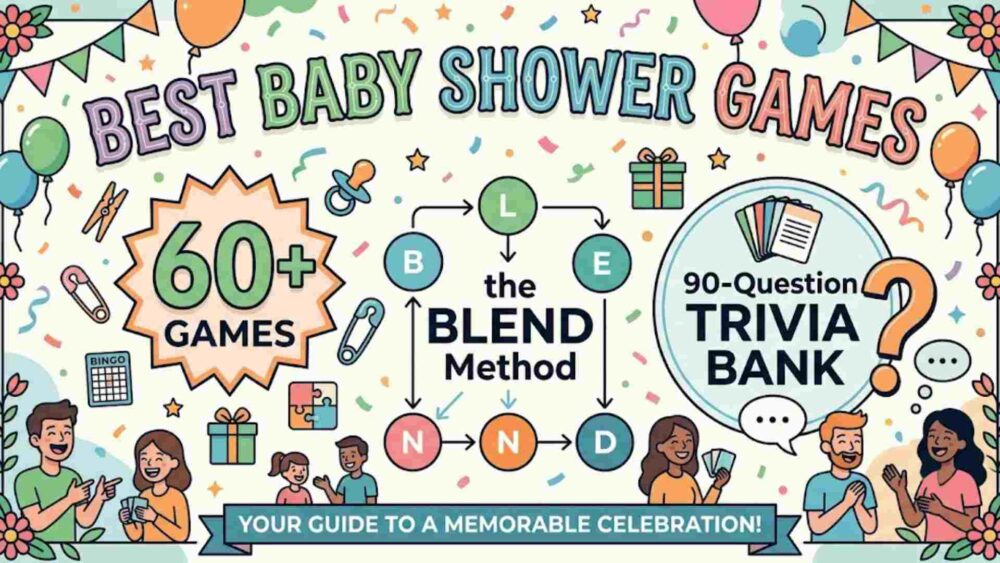
BLEND is a sequencing framework for baby shower games: five categories of activity, run in a specific order, so energy builds naturally across the afternoon instead of spiking and crashing or sitting flat the whole time.
B — Break the Ice. Run these at arrival, before guests settle into groups. Their job is to give strangers a reason to talk that isn’t forced small talk. Low-stakes, self-directed, no gathering required.
L — Laughs. Once most guests have arrived and there’s some energy in the room, bring on the funny, competitive, slightly chaotic games that produce real noise — the ones still getting talked about on the drive home.
E — Emotional Keepsake. One anchor activity that produces something lasting: an object the parents keep, something the baby looks at someday, or a moment of real feeling in the room. Runs mid-afternoon, after the L games, as a gear change before gifts.
N — New Parents Spotlight. Games that put the parents-to-be front and center — their story, their childhood, their predictions about the baby. These land best with the parents present and willing to play, which naturally lines up with gift-opening time.
D — Done Right. The closing activity: brief, participatory, warm. A toast, a prediction card, a group message. Whatever gives the afternoon a real ending instead of just petering out.
That’s the order: B → L → E → N → D. You don’t need one of every letter — just the right ones for your group. Treat this as a planning structure, not a checklist.
Ice Breaker Games for Arrival (B — Break the Ice)
These run the moment guests arrive and continue until the room fills up. The rule: no gathering required. People should be able to play solo or in pairs while getting drinks or finding a seat.
Baby Bingo (Table Version)
Place a bingo card and pen at each seat before guests arrive. Squares list baby-related words or gift items. As the mom-to-be opens gifts, guests mark them off; first to complete a row shouts “Bingo!” and wins a small prize. It’s one of the most reliable arrival games around because it starts the second guests sit down and runs itself through the whole gift-opening — no separate setup, no instructions needed.
Who Knows the Parents Best?
Hand guests a short quiz at the door — ten to fifteen questions about the parents-to-be: childhood nicknames, how they met, who cooks dinner. Reveal the parents’ real answers later, during the N section. The debate this sparks while people fill it out is worth more than the reveal itself.
Baby Photo Guessing Wall
Ahead of the shower, collect baby photos from guests and pin them up, numbered, on a board. Guests try to match each photo to the right adult. It takes advance prep — you need everyone to send a photo in — but the payoff is real: people spend the entire arrival window laughing at the wall and arguing over who’s who.
Baby Item Price Guessing
Display eight to twelve baby items, or photos of registry items, and have guests write price guesses on a numbered sheet. Closest total wins. It works as an arrival game because it’s self-directed and starts conversations between guests who’ve just met (“wait, how much is a good baby monitor?”).
Words of Wisdom Station
Set up a small station at the entrance — cards, pens, a decorated box — and invite guests to leave one piece of advice or a memory for the parents as they arrive. It gives people something to do while others trickle in, and the cards become part of the E section later.
Funny Games That Work for Any Crowd (L — Laughs)
Run these once the room has filled and the energy needs somewhere to go. The test: does it produce real noise?
Don’t Say “Baby”
Give every guest a clothespin, bracelet, or sticker at arrival. Nobody’s allowed to say the word “baby” for the whole shower — catch someone saying it and take their pin. Most pins at the end wins. It runs quietly in the background all afternoon, producing small bursts of surprise without any host management.
Baby Item Charades
Split guests into teams. One player per team draws a baby item from a hat — bottle, monitor, swaddle blanket, breast pump, diaper bag, carrier — and acts it out for their team. The more awkward to mime, the funnier it gets. High-energy, loud, and a good fit for groups comfortable being a little ridiculous.
Diaper Drawing Race
Give each guest a diaper and a marker. Sixty seconds to draw their best “masterpiece.” The mom-to-be judges and picks a winner — no artistic skill required, which is exactly what makes it funny. She keeps the diapers as a keepsake afterward.
Baby Name Alphabet Race
Teams race to fill in a baby name for every letter of the alphabet in three minutes, then read their lists aloud. Needs nothing but paper and pens, and the weirder names keep the conversation going well after the timer stops (“you actually know someone named Xylo?”).
Blindfolded Diaper Change
Two or three volunteers race to change a diaper on a baby doll, blindfolded, while the audience shouts instructions (or doesn’t, depending on how mean you want to be). Keep it to one round — about five minutes is plenty.
Baby Food Taste Test
Buy six to eight jars of baby food, strip the labels, number the jars. Guests taste and guess the flavor. Confidence collapses the moment nobody can see the label, and watching someone insist a jar is “definitely peach” when it’s squash never gets old. Keep it optional for anyone who’d rather skip the tasting.
Who Said It: Mom or Dad?
Before the shower, interview both parents separately — “what scares you most?”, “what baby name got vetoed immediately?”, “what’s your prediction for the baby’s personality?” — and record their answers. At the shower, read each one aloud and have guests guess who said it, with the parents on hand to react live. Funny and personal in a way generic games aren’t.
Games About the Parents-to-Be (N — New Parents Spotlight)
These put the parents at the center of their own shower, and work best around gift-opening time when attention’s already on them.
Mommy or Daddy?
Write twenty questions predicting which parent is more likely to do something after the baby arrives: who gets up for the 3 a.m. feed, who buys unnecessary gadgets, who cries at the first pediatrician visit. Guests mark their guesses, then the parents reveal their own predictions about each other. The laughs live in the gap between the two.
Finish the Nursery Rhyme
Read the first line of classics — Humpty Dumpty, Jack and Jill, Baa Baa Black Sheep — and have guests finish them from memory. Plenty of adults can start a nursery rhyme and cannot finish it, which is funny and mildly alarming given these are the people now responsible for raising a child.
Guess the Due Date
Everyone predicts the exact birth date, time, and weight, sealed in envelopes. The parents open it later, or post the winner in the group chat after the birth. Simple, personal, no supplies needed.
Predict the Baby’s Future
Guests write one prediction about the baby’s future personality — “will be a morning person,” “will lose everything they own” — read aloud as you go. The parents keep the cards to compare against reality as the child grows, which makes this a game and a keepsake in one.
Creative and Keepsake Activities (E — Emotional Moment)
Every shower should have at least one activity that produces something the parents keep. This is the gear change between the funny games and gift-opening — remembered not because it was hilarious but because it actually meant something. If you’re also planning what guests bring, our guide to heartfelt ways to congratulate new parents has message templates that pair naturally with a few of these.
Onesie Decorating Station
Set up plain white onesies in various sizes with fabric markers and iron-on patches. Guests design one for the baby to wear. Every guest ends up with a story behind what they made, the parents actually use the finished onesies, and the results are a mix of beautiful, funny, and “I can’t believe an adult made this.”
Book Signing Station
Instead of, or alongside, a traditional guest book, set up children’s books and ask each guest to write a message inside the cover — a memory, a piece of advice, a favorite line, a wish for the baby. The parents end up with a shelf of personalized books, and the baby reads the messages growing up. This is a keepsake that gets more meaningful with time, not less.
Letters to the Baby
Give each guest a card and ask them to write a short letter the baby will read someday — who they are, how they know the parents, a piece of advice for when life gets hard. Seal the envelopes; the parents hand them over at a milestone — eighteenth birthday, graduation, wedding day. One of the most moving activities available at a shower, and it needs nothing but cards and pens.
Advice Jar
Set out a jar and blank cards and invite guests to leave their best piece of parenting advice, unsigned if they’d rather. The jar goes home with the parents, who pull a card out on rough nights. Simple on paper, but it often produces the single most emotional moment of the afternoon when the parents sit with it later.
Paint the Onesie Contest
A competitive spin on the onesie activity — teams race to design the best onesie in ten minutes, judged by the parents. Competition adds energy, the keepsake adds meaning; works well as a bridge between the L and E sections.
Co-Ed Baby Shower Games (The Big Shift)
Co-ed showers — partners, friends of every gender, family across the guest list — are the standard now, not the exception, and most game guides haven’t caught up. The issue isn’t that traditional games are exclusively for women; it’s that a lot of them were built for a social dynamic that doesn’t match the room at most modern showers.
Co-ed games need to work across a wider range of comfort levels. They shouldn’t assume everyone already knows the mom-to-be’s personal history — plenty of the dad’s friends won’t. They should lean on competition or team energy rather than requiring emotional openness from near-strangers. And they need to land as funny across a mixed group, not just with the women in the room. The following are built around exactly that.
Dad Bod Olympics
A relay of physical challenges that mimic parenting tasks: diapering a baby doll against the clock, assembling flat-pack furniture from a sixteen-step instruction sheet, picking an object off the floor while holding a balloon under your shirt to simulate the third trimester. Divide into teams, run it relay-style. Loud, inclusive regardless of gender, and reliably produces the best photos of the day.
Baby Gear Price Is Right
Show photos of baby gear — carrier, crib mattress, white noise machine, video monitor, bottle sterilizer, stroller — and have guests bid closest-without-going-over on each price. Almost everyone is surprised by how expensive baby gear actually is, and that shared surprise is what makes it work in mixed company: nobody has an unfair edge from prior experience.
Baby Trivia (Science and Weird Facts Edition)
Standard baby trivia tends to favor guests who already have kids or know the couple well. The science-and-weird-facts version — how many bones babies are born with, what sense is fully developed at birth, when babies start laughing — levels the field and produces real surprise across the room. The trivia bank below has plenty for a full round.
Build-a-Baby-Story
Go around the circle, each guest adding one sentence to a story about the baby’s future life, two minutes per person, with the host writing it all down to read back at the end. The result is usually completely surreal and a keeper for the parents.
Parenting Advice Battle
Pair guests up to debate a parenting topic — screen time before age two, the pacifier question, co-sleeping, the right age for a first phone — and let the room vote on a winner. Nobody’s actually trying to influence real decisions; it’s the absurdity of debating these like formal motions that lands. Let the parents-to-be judge the final round.
Target Practice (Diaper Toss)
A laundry hamper as the target; players throw a rolled diaper from increasing distance. Physical, competitive, zero setup, and exactly the kind of ridiculous a co-ed shower needs when energy starts to dip.
Virtual Baby Shower Games
Virtual showers aren’t a workaround anymore — family is genuinely scattered, not everyone can travel, and some guests simply prefer joining from a screen. The games that work in person need real adaptation for a screen-based format, not just a claim that they “work virtually too.”
Virtual Baby Bingo
Email digital bingo cards ahead of time using a free tool like Bingo Baker, or build your own in Google Slides. As the mom-to-be opens gifts on camera, guests mark cards and type “BINGO!” in the chat. Works exactly like the in-person version, just digital.
Virtual Price Guessing
Screen-share a slide deck with one baby item per slide. Guests type price guesses in chat before the reveal. Simple to run, and the reaction to the monitor’s price lands the same over video as it does in a living room.
Kahoot Baby Trivia
Build a free trivia round in Kahoot using questions from the bank below and share the join code at the start of the call. Kahoot handles timing, scoring, and the leaderboard — you just read the questions. The single most reliable virtual game for groups of ten or more.
Virtual Scavenger Hunt
Call out items and give guests sixty seconds to find something in their home that fits: “something that belonged to you as a baby,” “something yellow,” “the first baby item you spot in your house.” People sprint off-camera and come back laughing and out of breath — it does more for a virtual room’s energy than almost anything else on this list.
Virtual Letters to the Baby
Give each guest two minutes to write a message to the baby, then share it on camera — what they wish for them, what they hope to teach them, a promise. Looser and more spontaneous than the written version, and it tends to produce a genuinely warm ten minutes in an otherwise lighthearted call.
The Baby Trivia Question Bank: 90+ Questions, Ready to Use
Copy these directly, split into rounds, or pick a selection. Categories cover biology and development, classic parenting knowledge, celebrity baby facts, and questions built around your specific couple.
Baby Biology and Development (20 Questions)
- How many bones does a newborn baby have? (300)
- How many bones does an adult have? (206 — babies have extra cartilage that fuses as they grow)
- At what age do most babies start smiling intentionally? (around 6 weeks)
- What color do babies see most clearly at birth? (red)
- How far can a newborn see clearly? (8–14 inches, roughly the distance to a caregiver’s face)
- What is the soft spot on a baby’s head called? (the fontanelle)
- Are babies born with kneecaps? (no — cartilage develops into kneecaps later)
- What reflex makes a baby fling out their arms when startled? (the Moro reflex)
- What reflex turns a baby’s head toward a touch on the cheek? (the rooting reflex)
- At what age do babies typically start laughing? (around 3–4 months)
- When do babies typically start sleeping through the night? (varies widely; “through the night” is usually defined as 5–6 hours straight)
- Can newborns cry tears? (no — real tears appear around 3–4 weeks)
- How much of a newborn’s body weight is water? (roughly 75–78%)
- At what age do babies typically start walking? (9–12 months, with a normal range up to 18 months)
- What sense is nearly fully developed before birth? (hearing, along with touch)
- How many hours a day do newborns typically sleep? (14–17 hours, in short stretches)
- What color is a newborn’s first bowel movement? (almost black — called meconium)
- At what age do babies usually recognize their own name? (around 6 months)
- What’s the average birth weight in the U.S.? (about 7.5 pounds)
- When do fingerprints form? (in the womb, between weeks 10 and 24)
Parenting Knowledge (20 Questions)
- Roughly how many diapers does a newborn use in the first month? (around 250–300, 8–10 a day)
- What does “swaddling” mean? (wrapping a baby snugly to mimic the womb)
- What’s the “fourth trimester”? (the first three months after birth)
- What are Dr. Harvey Karp’s five “S’s” for calming a fussy baby? (Swaddle, Side/Stomach, Shush, Swing, Suck)
- When should solids generally be introduced? (around 6 months)
- What’s the safe sleep guideline for newborns? (on their back, firm flat surface, own sleep space, nothing loose in the crib)
- What is “tummy time” for? (building neck, shoulder, and arm strength)
- What are classic signs of teething? (drooling, fussiness, chewing on objects, swollen gums, disrupted sleep)
- When does teething usually start? (around 6 months, with a normal range of 3–12 months)
- What does “latch” mean? (how a breastfeeding baby attaches)
- What’s a “cluster feed”? (frequent short feeds over a few hours, often in the evening)
- What’s a baby “onesie”? (a one-piece bodysuit that snaps at the crotch)
- What is “colostrum”? (the nutrient-dense first milk produced after birth)
- What’s a “Snoo”? (a smart bassinet that mimics womb motion and sound)
- What’s a burp cloth for? (protecting clothing during burping)
- What does “colicky” mean? (crying over 3 hours a day, 3+ days a week, for 3+ weeks, with no clear cause)
- What’s a “sleep regression”? (a stretch where a baby who was sleeping well starts waking often, often tied to a developmental leap)
- What makes a swaddle blanket different from a regular one? (it’s shaped or weighted to stay secure)
- What is “responsive feeding”? (feeding on demand based on hunger cues, not a fixed schedule)
- What are common newborn hunger cues? (rooting, sucking on hands, turning the head — crying is actually a late signal)
Random Baby Facts Round (20 Questions)
- True or false: babies are born able to swim. (mostly true — reflexes let newborns briefly hold their breath and move in water, fading after a few months)
- What’s the record for most babies born to one mother? (69, to an 18th-century Russian woman — 16 twin, 7 triplet, and 4 quadruplet pregnancies)
- What percentage of babies arrive on their actual due date? (about 4–5%)
- Which country’s babies statistically sleep the most? (New Zealand, per research cited by Johnson’s Baby — around 13 hours a day)
- Roughly how many babies are born worldwide each day? (around 385,000)
- What’s the most common birthday in the U.S.? (September 9 — nine months after New Year’s Eve)
- True or false: newborns have more taste buds than adults. (true — spread across more of the mouth)
- What’s a “moon face” in a newborn? (the puffy look caused by birth and fluid retention)
- What does “kangaroo care” mean? (skin-to-skin holding, especially valuable for premature babies)
- Is a newborn’s brain closer in size to an adult’s or much smaller? (about a quarter the size, reaching 80% of adult size by age three)
- Can babies feel pain? (yes — pain response develops in the third trimester)
- What’s a baby’s first non-reflex smile called? (a “social smile,” typically around 6 weeks)
- How fast does baby hair grow? (about half an inch a month, similar to adults)
- True or false: all babies are born with blue eyes. (false — a common myth; eye color is genetic from birth, though it can shift in year one)
- What does NICU stand for? (Neonatal Intensive Care Unit)
- How long is a full-term pregnancy? (37–40 weeks)
- Can twins have different birthdays? (yes, around midnight or during a long labor)
- What’s the term for a baby born before 37 weeks? (premature or preterm)
- What’s the first stage of language development called? (babbling, starting around 6 months)
- What product was invented to replace hospital staff rocking babies to sleep? (the baby swing)
Celebrity Baby Round (15 Questions)
- What did Elon Musk and Grimes name their first child? (X Æ A-12)
- Which couple named their daughter Blue Ivy? (Beyoncé and Jay-Z)
- What did Gwyneth Paltrow name her daughter? (Apple)
- Which celebrities named their kids North, Saint, Chicago, and Psalm? (Kim Kardashian and Kanye West)
- What did Rihanna name her first son? (RZA Athelston Mayers)
- Which couple had twins named Rumi and Sir? (Beyoncé and Jay-Z)
- What’s the name of Prince Harry and Meghan Markle’s daughter? (Lilibet Diana)
- What name did Kylie Jenner first give her son before changing it? (Wolf, later Aire)
- Who named their child Cricket Pearl? (Busy Philipps)
- What did Megan Fox and Machine Gun Kelly name their daughter? (Journie Rose)
- Which royal baby’s name honors two queens and a princess? (Lilibet Diana)
- What unusual name did INXS’s Michael Hutchence give his daughter? (Heavenly Hiraani Tiger Lily)
- Who named their twins Moroccan and Monroe? (Mariah Carey)
- What are the Beckham children’s names? (Brooklyn, Romeo, Cruz, Harper)
- Who named their son Pilot Inspektor? (Jason Lee)
About This Baby Round (Use your own answers — 15 template questions)
Swap in real facts about your couple before the shower and read these aloud as guesses.
- What is the baby’s due date?
- What’s the first name suggestion that got vetoed immediately?
- Who found out about the pregnancy before anyone else?
- How did the couple announce it?
- What’s the parents’ own prediction for the baby’s personality?
- Which parent do they think the baby will look most like?
- What has the mom been craving most?
- What’s the one thing they’re most excited about?
- What’s the one thing they’re most nervous about?
- What was the first thing packed in the hospital bag?
- What’s the nursery theme?
- What song is most likely to be the baby’s first lullaby?
- Which parent will be the stricter one?
- What nickname do they expect the baby to end up with?
- What’s the one parenting rule they’ve already agreed on?
No-Prep, Zero-Supply Games
For hosts short on time, or for filling ten minutes without a supply bag — these need nothing but the people already in the room.
Two Truths and a Baby Lie
Each guest shares two true statements about babies or parenting and one lie; the group guesses which is false. Works well in mixed groups because people with and without kids both have a fair shot at guessing convincingly.
The Name Game
Go around the circle. Each person has five seconds to name a baby name starting with the last letter of the previous one. Miss the timer, you’re out. Last one standing wins — no supplies, fast pace.
Baby Predictions Hot Seat
The parents-to-be sit facing the group while guests shout predictions about the baby’s personality, quirks, or future career, and the parents respond live. Keep it playful — the back-and-forth is where the laughs are.
Finish My Sentence
The host reads a sentence starter and guests complete it: “The best thing about having a baby is…”, “The thing no one tells you about the first year is…”, “This baby is definitely going to grow up to be…” Fast, funny, and produces lines people quote a year later.
How to Run the Games: Timing, Prizes, and Flow
Sequencing matters almost as much as the games themselves. A run-of-show for a two-and-a-half-hour shower looks roughly like this:
Arrival (30 minutes): B games running in the background — guests filter in, grab drinks, fill out the arrival quiz, look at the photo wall. No gathering required.
First full game (15–20 minutes): Your first L game once most guests are in. Something with teams or mild competition, built to produce noise.
Second game (10–15 minutes): A second L game or the N game — shorter, a bit more personal.
E activity (20–30 minutes): The keepsake station, running alongside food. No full-group participation needed; people drift in and out.
Gift opening (30–45 minutes): Run the N games here — Mommy or Daddy, Guess the Due Date — while Baby Bingo cards stay in play.
Closing (5–10 minutes): The D moment — a toast, a group letter, reading the advice jar aloud.
On prizes
Prizes don’t need to be elaborate: a candle, bath products, a good chocolate bar, a local gift card. What matters is that someone visibly won something — keep a stash ready and hand prizes over the moment someone wins rather than saving the announcement for later.
On managing the group
The host’s main job during games is energy management, not instruction. Explain the rules in under thirty seconds, start the game, and adjust as you go. If a game clearly isn’t landing after five minutes, cut it without apology and move to the next thing.
The One Activity That Beats Every Game on This List
This isn’t a game. It’s the most emotionally powerful thing you can do at a baby shower, and it’s underused mostly because it needs a bit more planning than a round of Baby Bingo.
Here’s the idea: before the shower, collect short personalized video messages from everyone who loves the parents — family who couldn’t make it, college friends, a childhood best friend across the country, grandparents. Each person records 30–60 seconds talking to the parents about what this baby means to them, what they’re excited to watch the parents become, what they’re looking forward to sharing with the child down the line.
Compile the clips. At the right moment — after the games, around gift-opening — play them for the parents in front of the room.
The effect is something no game replicates: the parents see the full circle of people surrounding this new life, including everyone who couldn’t be in the room. The guests present get to watch the parents receive it. The room goes quiet in the specific way a room only goes quiet when something actually matters.
MessageAR was built for exactly this kind of moment. Share one contributor link with everyone you want involved — they record from their own phone or browser, no app required — and the clips collect automatically in one place. You can deliver the finished tribute as an augmented reality experience: the parents hold up a card, point their phone at it, and the people in their life appear in front of them, one at a time. It isn’t a slideshow. It’s the kind of shower gift parents still bring up years later. If the couple is planning to share the birth news the same way, our guide to making an announcement video walks through recording and sharing that moment too.
If you take one thing from this whole guide, make it this: start collecting a video tribute from the people who can’t be there, and give everyone two weeks’ notice to record. Give the parents something that still matters when the baby is asking to watch it again at age seven.
Frequently Asked Questions
How many games should a baby shower have?
Two to four games across a two-to-three-hour shower is the right range for most groups. More than that and the afternoon starts to feel like a game show instead of a celebration — enough structure to give the day shape, not so much that guests feel herded from activity to activity. The BLEND Method helps you land on the right number: one activity from each category you actually need, in order.
What if guests don’t want to play games?
Some groups genuinely don’t want structured games, and that’s completely fine. Arrival ice breakers, the advice jar, and onesie decorating are all opt-in — guests can skip them without disrupting anything. If the room clearly isn’t in a game mood, pivot to conversation, food, and the keepsake activity, which work without group participation. Don’t force a group game on a room that wants to be left to talk.
What are the best games for a large baby shower — more than 25 guests?
Large groups need games everyone can play at once, not games where one person performs for the rest. Baby Bingo, price guessing, baby trivia (especially via Kahoot), the Don’t Say Baby clothespin game, and the Baby Photo Wall all hold up at scale because they’re self-directed or team-based. Skip anything that needs full-group silence or watching one person at a time — it loses the room fast past about fifteen guests.
What makes a good baby shower game prize?
Small, nice, broadly appealing: a quality candle, a coffee shop gift card, a good chocolate bar, a small plant, a bath product. The prize matters less than the timing — hand it over the moment someone wins, not at the end of the shower. The immediacy is what makes winning feel like something.
Are baby shower games mandatory?
Not at all. A baby shower doesn’t need games any more than a birthday dinner needs party games. They help groups that don’t know each other well, showers with a longer time window to fill, and hosts who want built-in memorable moments. For a small, close-knit gathering, conversation and shared excitement often outperform any organized game. Know your group before you build the program.
What is the best single game for a co-ed baby shower?
For most co-ed groups, the Mommy or Daddy? quiz — guests predicting which parent will do various parenting things — is the strongest single option. It’s personal, funny, naturally includes both parents, and needs almost no prep beyond writing the questions. One game only? Make it this one.
What is the most emotional baby shower activity?
Letters to the Baby, where guests write a message the child will one day read, reliably produces the most emotional response of any shower activity. The Advice Jar is a close second. Both work because there’s no performance involved — just an invitation to say something true. Parents sit with these long after the shower ends.
Should baby shower games have winners and prizes?
For the L and N games, yes — competition is part of what makes them energetic. For the E and D activities, no. Keepsake and closing moments exist for collective participation, not individual performance, so mix the two types on purpose: games with winners, activities without.
Related reading: Baby Shower Gifts: 150+ Ideas · Heartfelt Ways to Congratulate Someone on a New Baby · Best Gifts for Parents: 100+ Thoughtful Ideas · How to Make a Baby Announcement Video · Best Birthday Gifts for Mom
About the Author
Vivek Raj writes MessageAR’s guides on gifting and celebration planning, drawing on direct research into event formats, reader feedback from hosts who’ve run these showers, and hands-on testing of the games and activities recommended here. Have a game that worked (or bombed) at your shower? It may get added to a future update of this guide.